

Video War Games
What Happens When You Realise You’re the Baddies?

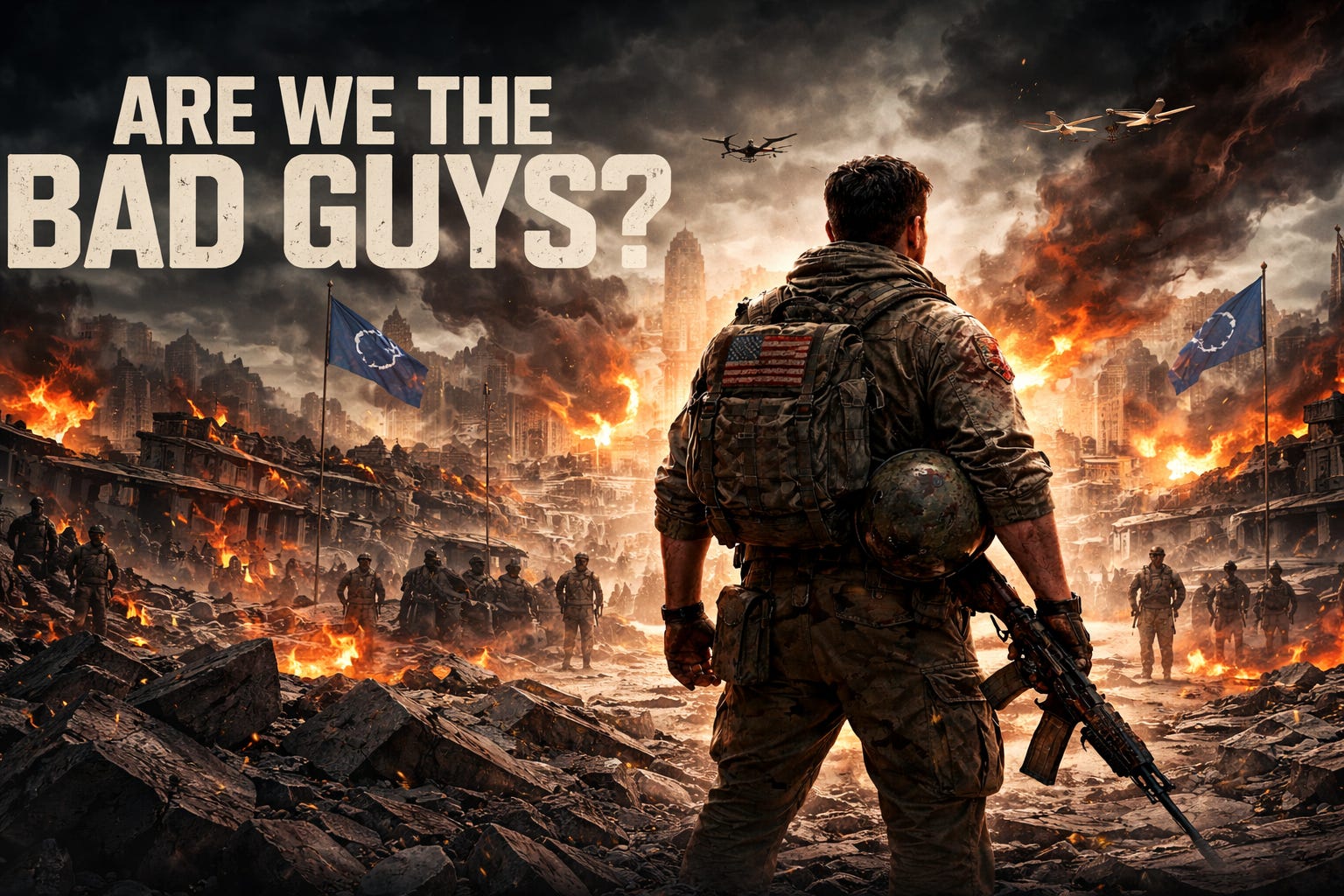
I once asked a German friend how younger Germans felt about video games set in the Second World War.
You know the ones. The glossy, orchestral, testosterone-drenched affairs where you storm beaches, clear villages, and mow down endless waves of identically dressed enemy soldiers who exist solely to be shot in the face for narrative progression.
I asked him how it felt, generation after generation, to be the enemy. To always be on the wrong side of the rifle. To only ever appear in games as silhouettes to be cleared, obstacles to be removed, historical NPCs whose only purpose is to die noisily so the player can advance to the next checkpoint.
His answer was refreshingly blunt.
“We don’t.”
They just don’t buy them. They don’t play them. They don’t even sell them. They don’t emotionally invest in interactive power fantasies where their grandparents’ uniforms are the default target practice. No protests. No outrage campaigns. No grand statements. Just a quiet consumer decision: this story is not for us.
And that, right there, is the crack in the façade that the Western video games industry is now staring straight into.
Because the industry has spent decades assuming one unshakable constant:
The player is Western.
The player is morally right.
And the enemy is whoever the West says it is.
That assumption is beginning to rot.
The Quiet Giant No One Talks About
The video games industry is now a multi-billion-dollar colossus. Not “Hollywood big”. Bigger. More profitable. More immersive. More psychologically sticky.
Hollywood tells you a story for two hours.
Games ask you to inhabit it.
They don’t just show you who the villain is — they wire that assumption directly into your muscle memory. Press X to reload. Press R to throw the grenade. Press forward to clear the room. Morality isn’t debated; it’s mapped to the controller.
And for a long time, this worked beautifully — because Western audiences were comfortable with the premise.
Nazis. Soviets. Generic Middle Eastern insurgents with interchangeable accents and an alarming lack of surnames. Terrorists. Warlords. Rogue states. The narrative was clean. The kill feed morally frictionless.
But here’s the problem the industry didn’t anticipate:
Players grew up.
Information escaped the gatekeepers.
And the “good guys” started to look… familiar.
When the News Starts Bleeding Into the Controller
We are now deep into the 2020s, and younger Western audiences are watching real-time footage of drone strikes, collapsed hospitals, proxy wars, sanctions regimes that starve civilians, and NATO press conferences that sound increasingly like brand damage control.
They’re seeing leaked documents.
They’re watching whistleblowers get exiled or imprisoned.
They’re seeing “rules-based orders” bend like cheap plastic the moment they inconvenience power.
And then — in the evening — they’re being asked to boot up a game where:
Western special forces are unambiguously heroic
NATO-aligned factions are always stabilising forces
Civilian casualties are either invisible or narratively justified
And anyone resisting Western military presence is, by default, an extremist
The cognitive dissonance isn’t subtle anymore. It’s loud. It hums. It ruins immersion.
Once you’ve watched the real footage — not the press release, not the cinematic reenactment — you can’t unsee it. You can’t un-know it. And you sure as hell can’t keep pretending that history neatly sorts itself into “us” and “targets”.
The fantasy collapses.
The German Problem Is Becoming a Western Problem
Germany dealt with this decades ago. Through education, through cultural reckoning, through a national agreement that mythologising your own violence is a dead end.
The West, by contrast, outsourced its moral accounting to entertainment.
Wars became settings.
Bombings became mechanics.
Occupation became a backdrop texture.
But now Western players are inching toward the same moment Germany hit after the war:
What happens when you no longer want to play yourself as the hero?
What happens when every new “modern warfare” title feels less like escapism and more like PR?
The result isn’t outrage.
It’s disengagement.
Quietly skipped releases.
Shrinking enthusiasm.
Sarcastic TikToks.
“I’m not buying this shit” comment sections.
The same consumer behaviour my German friend described — just scaled globally.
You Can Already See the Cracks Forming
Look at what is gaining traction instead.
Indie games that avoid clear moral binaries
Strategy games that expose systemic cruelty rather than celebrate firepower
Historical games that emphasise civilian survival, scarcity, and moral compromise
Non-Western studios telling stories where the West is absent, peripheral, or explicitly destabilising
Look at social media:
War clips reframed with irony instead of reverence
Military aesthetics stripped of heroism and repackaged as absurdity
Memes that mock press briefings, defence contractors, and “precision strikes”
Younger audiences fluent in the language of propaganda — and bored by it
And crucially:
Look at purchasing decisions.
People aren’t boycotting loudly. They’re just opting out. The most dangerous thing for a cultural industry isn’t criticism — it’s indifference.
The Industry’s Coming Identity Crisis
The games industry is heading toward an unavoidable fork in the road.
Path one: double down.
More cinematic bombast. More Western hero narratives. More morally sanitised conflict. More consultants from defence departments whispering about “authenticity”.
That path leads to diminishing returns, shrinking cultural relevance, and a player base that ages out without being replaced.
Path two: reckon with reality.
Allow moral ambiguity.
Allow Western power to be questioned.
Allow the player to feel discomfort.
Allow the possibility that you are not the protagonist of history.
This is riskier.
It will upset sponsors.
It will attract accusations of being “anti-Western”.
It will be called political — as if the previous decades weren’t.
But it will also be honest.
And honesty is becoming commercially valuable again.
The Future Isn’t About Who Wins — It’s About Who Refuses to Play
Here’s the uncomfortable prediction the industry is only beginning to grasp:
The next generation doesn’t need to be convinced the West is evil.
They just need to stop being convinced it’s automatically good.
And once that happens, the entire design philosophy of war games collapses.
Because you can’t build a power fantasy on moral certainty when the audience no longer grants you any.
The German kids didn’t protest WWII shooters.
They didn’t argue about them.
They didn’t demand change.
They simply said, this story isn’t for me, and didn’t buy it.
The West is catching up to that moment — controller in hand, newsfeed still open, wondering why pressing “Start Mission” suddenly feels less like entertainment and more like self-deception.
And that’s the real game changer.
Not a new engine.
Not better graphics.
Not bigger explosions.
Just the quiet, irreversible moment when the player realises:
I don’t want to be this character anymore.
If you made it this far, congratulations — you survived the article. Possibly even enjoyed it. Thank you.
One slightly boring but annoyingly important thing to know: because this piece is free, Substack’s algorithm treats it like a well-argued pamphlet handed out on a windy street corner — admirable, but largely ignored. The only way it escapes that fate is if actual humans do something with it.
If this made you think, nod, sigh, swear quietly, or forward it mid-paragraph to That One Person, please hit Share above. And not just here — Bluesky, WhatsApp, group chats, emails, Insta-hell, the app formerly known as Twitter, wherever discourse goes to loiter. This is how independent writing spreads now: person to person, not platform to algorithmic miracle.
If you want more of this — past, future, and whatever unsettling thing I’m currently digging into — hit Subscribe below. It’s free, unlocks everything, and tells the algorithm I’m not just yelling into the void on my own.
If you’re able and inclined to support the work financially, a few options:
There’s a Tip Jar below if you want to throw in whatever feels right
One-off support is always welcome and genuinely appreciated
Or there are paid subscriptions
A quick note on that last one: Substack has quietly decided that the cheapest paid tier is now $5 a month. That’s not my choice, I don’t love it, and I’m very aware that people often support multiple writers (which you absolutely should). The reason I even mention paid subscriptions isn’t about income — it’s because Substack aggressively promotes writers who have any paid subscribers at all.
So if $5 feels fine and you value the work, thank you — it genuinely helps it reach more people. If it doesn’t, please don’t. Subscribe for free, share the piece, leave a comment. That costs nothing and helps more than the algorithm would like you to know.
And if you’ve got thoughts, disagreements, additions, or want to argue with me politely or otherwise — the comments are open.
Thanks for reading, for sharing, and for keeping independent writing alive on an internet that would very much prefer sponsored content and vibes.
— James
So true, so far in Palestine, the fascist nazi zionsits with, his bloody buddy, whe Inommable mass killer, the Butcher of GAZA : more than 700 000 of wich more than 400 000 Children. Amd this without listing the undred thouzand Palestinians People under tje rubbles.
And it’s the fascist nazi zionist colonialism want to cover their crimes with the insane propaganda of the broad of "‘peace’ t to build fastl on Gaza ruins so that no expert of crimw can get anydence. It’s the utmost crime human being can do.
trump ans his bloodily mass killer, benjamin natanyahu is to depopulate Palestine by erazing Palestinian citizens of Palestine State.
i feel there's also a third option companies are taking in their war games, which is take the same franchise and make it either supernatural or futuristic in an attempt to be unrecognizable from the real world. but a lot of times this creates even further disconnect. the novelty of just *playing* the game itself has worn off, and players are itching for more emotional depth.