

The Line That Moved.
Aboriginal Australians never crossed a border. Most Mexican Americans didn’t either. The line moved around them — and two education systems have spent generations making sure nobody notices.

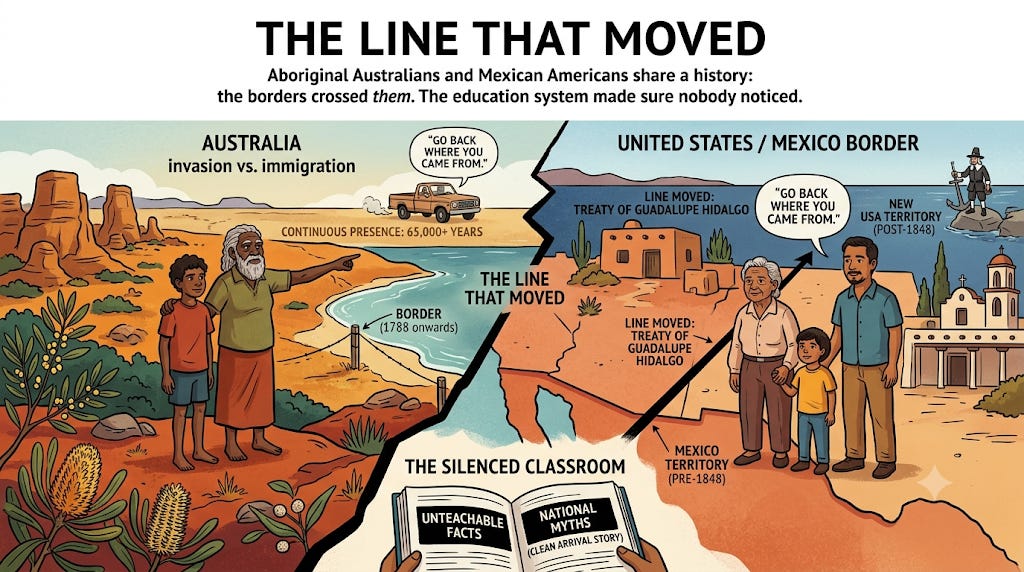
Picture the scene. Somewhere in outback Australia, a Ford Ranger idles at a servo (Aussie for petrol station) while its owner tells a group of Aboriginal teenagers to “go back where you came from.” It’s a genuinely popular sentence in the Anglosphere in 2026, endlessly recyclable, infinitely portable. The only problem, in this instance, is geography. The teenagers are already there. Have been, give or take, for around 65,000 years — a span so long that the last Ice Age happened during their tenancy, not before it.
Now picture a second scene, four thousand kilometres north of the Mexican border and several centuries deep. A family in Santa Fe, New Mexico, gets the same instruction. Also geographically confused, for a subtler reason: Santa Fe was founded as a colonial capital in 1610, a full decade before the Mayflower dropped anchor at Plymouth Rock. Some of the people being told to leave have never lived under a Mexican flag at all — not because they arrived after Mexico lost the territory, but because their ancestors were there when it was the territory, watched it become part of the United States without moving an inch, and have been paying US taxes about it ever since.
These two scenes look unrelated. One is about invasion. The other is about a border that got up and walked six hundred miles west without asking anyone’s permission. Look at them side by side and a pattern appears — the same pattern that shows up again in Canada, in Latin America, in India, in Japan, wherever a settler state needed a founding story simple enough to fit on a citizenship test. The pattern is this: the people accused of arriving are, overwhelmingly, the people who were already there. And the education systems built on top of that inversion have been remarkably, suspiciously good at keeping it that way.
Terra Nullius and the Art of Legal Fiction.
Australia’s founding myth needed a specific piece of legal machinery to work: terra nullius — land belonging to no one. Britain claimed the continent in 1788 on the basis that the people already living on it didn’t have the kind of civilisation that counted as ownership. This wasn’t an oversight. It was a doctrine, and it stayed in place until 1992, when the High Court’s Mabo decision finally admitted, 204 years late, that Aboriginal and Torres Strait Islander people had in fact been living under structured legal and land systems the entire time.
Everything downstream of that founding lie compounds. Aboriginal and Torres Strait Islander people were not counted in the national census until after the 1967 referendum — not because a census-taker forgot to knock, but because Section 127 of the Constitution specifically instructed that they not be counted for the purposes that mattered: seats in parliament, shares of federal funding. They didn’t get a guaranteed right to vote in federal elections until the Commonwealth Electoral Act of 1962, and even then, enrolment wasn’t compulsory — full electoral equality didn’t arrive until 1984. For context, that’s within living memory of people who are, right now, complaining on Facebook about immigrants “jumping the queue.”
Today, Aboriginal and Torres Strait Islander people make up roughly 3.2% of Australia’s population — around 812,000 people at the last census, likely closer to a million once undercounting is factored in — and they carry the oldest continuously surviving culture on Earth. They also carry a life expectancy gap of roughly eight years against the non-Indigenous population, and in 2023 the country was asked, via referendum, whether it would formally recognise them in the Constitution through a consultative Voice to Parliament. It said no. Not narrowly — decisively, in every state. Whatever else that result means, it is not evidence of a nation confident in its own history.
None of this is a story about immigration policy. It’s not possible to “cross the border” into land you already inhabited before the concept of that border existed. What happened in Australia wasn’t migration in either direction. It was invasion, followed by roughly two centuries of legal and bureaucratic effort to make the invasion look like an empty transaction — one party arriving, nobody there to greet them.
The Same Story, Written in Different Handwriting.
Cross the Pacific and the mechanism changes but the outcome doesn’t. Canada counted just over 1.8 million Indigenous people at its 2021 census — First Nations, Métis and Inuit combined, about 5% of the population — a figure inseparable from the residential school system that operated, in various forms, into the 1990s, and whose intergenerational consequences show up today in every measurable education and housing statistic. Latin America runs the same story at a different scale: tens of millions of Indigenous people across the region whose ancestors’ civilisations were, at the moment of European contact, frequently larger and more urbanised than the European cities their conquerors had sailed from. Japan spent the better part of a century pretending the Ainu people of Hokkaido didn’t exist as a distinct Indigenous population, only extending formal legal recognition in 2019. India’s Adivasi communities — a designation covering over 100 million people — remain, by most development indicators, the most disadvantaged population bloc in the country that contains them.
The common denominator isn’t the specific colonial method. It’s the sequencing: dispossession first, legal fiction second, education system third — the third step being the one that ensures the first two never have to be explained to anyone’s grandchildren.
Which Brings Us to the Line That Actually Moved.
If the Australian story is about a border that was never legitimate in the first place, the American story is about a border that used to sit somewhere else entirely — and moved not through any migration, but through war.
Until 1848, roughly half of what is now the continental United States — California, Nevada, Utah, most of Arizona and New Mexico, and chunks of Colorado, Wyoming and Oklahoma — was Mexican territory. Before that, for nearly three centuries, it was part of the Spanish colonial administration of New Spain. Santa Fe, as mentioned, predates the Pilgrims by a decade. This wasn’t unclaimed frontier waiting for a flag; it was a functioning, governed, Spanish-speaking territory with cities, courts and a Catholic Church infrastructure older than most European settlements on the eastern seaboard.
Texas is the more tangled case, and worth being precise about rather than folding it into a single clean narrative: it broke away from Mexico as an independent republic in 1836, largely because Mexico had abolished slavery and the American settlers who’d colonised the territory had no intention of giving up theirs. Nine years later, the US annexed it, and pushed the disputed southern boundary from the Nueces River — Mexico’s claimed line — down to the Rio Grande, triggering the war that followed. The remaining territory — California, New Mexico, Arizona, Nevada, Utah — was ceded outright at the war’s end under the Treaty of Guadalupe Hidalgo, a “purchase” negotiated at gunpoint after the US Army had already occupied Mexico City.
The most useful character witness for how unjust this was isn’t a modern historian with an axe to grind. It’s Ulysses S. Grant — the general who later commanded Union armies and became president — who fought in the war as a young lieutenant and never stopped being ashamed of it. He called it, in his memoirs four decades later, one of the most unjust wars ever waged by a stronger nation against a weaker one, adding that the United States had no legitimate claim to the disputed territory and pushed the line anyway.⁹ This is not a fringe reading of events. It’s the recorded verdict of the man who fought there, on the record, in print, for anyone who bothered to read past the Wikipedia summary of the Alamo.
You’re Probably Not Even Talking About Who You Think You Are.
Here’s where the American version of this story develops a second, stranger layer that Australia’s doesn’t quite have an equivalent for: the sheer scale of the conflation involved. “Mexican,” in a lot of American political rhetoric, has been stretched to cover people who are citizens of Mexico, Americans of Mexican descent born generations ago, and — more loosely still — the entire 68-million-strong US Latino population, a category that includes Puerto Ricans (who have held US citizenship by birth since 1917), Cubans, Dominicans, Colombians, Salvadorans and Hispanic New Mexicans whose families have lived under Mexican, Spanish and American flags without their address ever changing.
Untangle the numbers and the “invasion” framing crumbles under its own weight. As of 2024, US Latinos numbered around 68 million people, and roughly two-thirds were born in the United States. Nearly four in five hold US citizenship. These aren’t people who “came here.” A majority never crossed anything — the same way the people of Santa Fe never crossed anything in 1848. The line simply relocated itself around them, care of an army and a treaty they had no say in.
So when someone in Albuquerque, San Antonio or East LA is told to go back where they came from, there is a genuinely accurate response available, and it isn’t defensive — it’s just geography: this is where I came from. The confusion only works if the listener doesn’t know the border used to be somewhere else. Which, per the evidence of most American public education, is a fairly safe bet.
The Part Where Education Did This on Purpose.
None of the above is obscure. It’s not buried in specialist journals or classified archives — Grant’s memoirs have been in print continuously since 1885, the Mabo decision is a matter of public record, the 1967 referendum results are on a government website. What’s remarkable isn’t that the information exists. It’s how successfully it’s been kept out of the rooms where national identity gets built: classrooms.
Australian curricula only began meaningfully integrating pre-invasion Aboriginal history and frank colonial violence in the last two decades, and continue to be a live political battleground — the so-called “history wars” pit historians documenting frontier massacres against politicians insisting the national story should stay comfortable. American history education, similarly, has managed to teach the Mexican-American War as a minor 1840s footnote rather than the single largest territorial land grab in the country’s history, one that fundamentally determined who gets asked for their papers in the twenty-first century and who doesn’t.
This is the actual throughline connecting Australia’s invasion, America’s moving border, Canada’s residential schools and every other case gestured at along the way. It was never really about the facts of who arrived when. It’s about which nations get to write their own founding myth as a clean arrival story — nobody home, nothing taken — and which populations are left holding a history too inconvenient to teach, because teaching it accurately would mean admitting that a significant number of the people currently being told to leave were the landlords the whole time.
Truth Decay exists because most of this information is one archive search away and most people are never handed the search terms. If this piece did that for you, the best way to keep it going is to subscribe — free subscriptions get every investigation, paid subscriptions (from $5/month) keep the lights on and the archives open.
Sharing it does more for reach than any algorithm will admit to.

References:
Bringing Them Home, Australian Human Rights Commission, “Historical Context – Ancient History,” https://bth.humanrights.gov.au/significance/historical-context-ancient-history
New Mexico Historic Sites, “Santa Fe founding history,”
https://nmhistoricsites.org
(general reference; see also National Park Service, “Santa Fe National Historic Trail”)
AIATSIS, “The 1967 Referendum,” https://aiatsis.gov.au/explore/1967-referendum
National Museum of Australia, “Indigenous Australians’ right to vote,” https://www.nma.gov.au/defining-moments/resources/indigenous-australians-right-to-vote
Australian Bureau of Statistics, “Aboriginal and Torres Strait Islander people: Census, 2021,” https://www.abs.gov.au/statistics/people/aboriginal-and-torres-strait-islander-peoples/aboriginal-and-torres-strait-islander-people-census/latest-release
Australian Electoral Commission, 2023 Referendum results, https://www.aec.gov.au/referendums/
Statistics Canada, “First Nations people, Métis and Inuit in Canada,” 2021 Census, https://www150.statcan.gc.ca/n1/pub/11-627-m/11-627-m2022057-eng.htm
Mises Institute, “The Unjustified Conflict: Grant’s Memoirs on the Mexican-American War,” https://mises.org/mises-wire/unjustified-conflict-grants-memoirs-mexican-american-war
U.S. Army, “Grant in Mexico: ‘One of the most unjust wars ever waged,’” https://www.army.mil/article/216806/grant_in_mexico_one_of_the_most_unjust_wars_ever_waged
Pew Research Center, “Facts about U.S. Latinos for Hispanic Heritage Month,” October 22, 2025, https://www.pewresearch.org/short-reads/2025/10/22/key-facts-about-us-latinos/
Pew Research Center, “How Latinos see their group’s situation in the US,” November 24, 2025, https://www.pewresearch.org/race-and-ethnicity/2025/11/24/how-latinos-see-their-groups-situation-in-the-u-s/
TD-2026-07-BorderThatMoved-001
Hamas Just Blinked. Israel Just Moved the Goalposts. Again.

This article has also been published on Manufacturing Dissent; I highly recommend subscribing to their newsletter as well.
So many fantastic replies here, many worthy of a restack (except I have no option to do that on my phone… Odd, because I’m sure I normally can. Anyway, thanks to you all for taking the time.
And...the most successfully cute lie of that type "A land without a people, for a people without a land."