

The Invoice...
Governments told you taxes paid for civilisation. They forgot to mention who civilisation is now being built to contain.

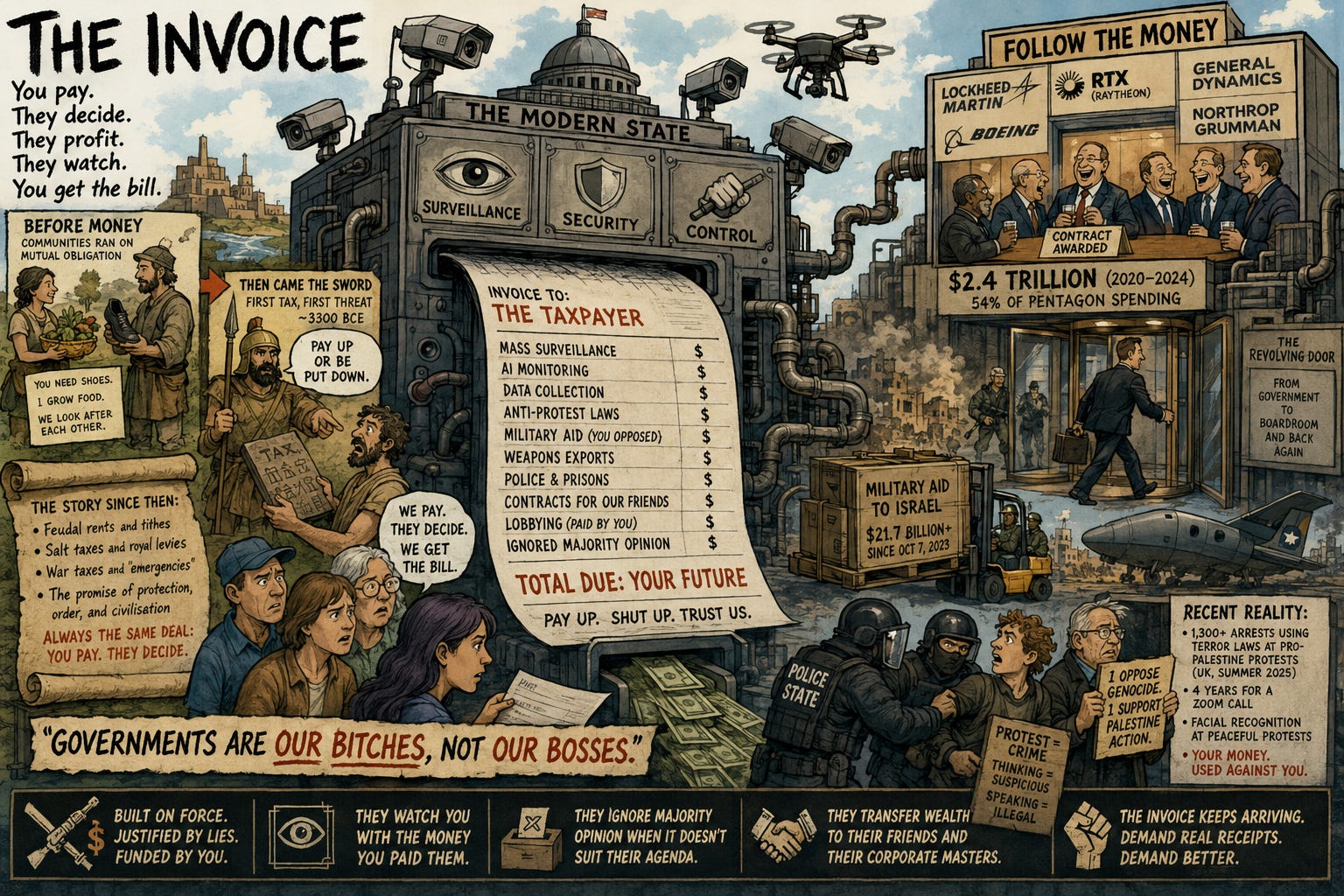
Before money, before markets, before the entire gleaming apparatus of modern capitalism, people got by without any of it. Not because they were primitive, and not because they bartered — that particular story is a fantasy that economists invented to justify their own origin myths. They got by because communities, almost universally and across cultures, were built on something simpler and more durable: mutual obligation. You made shoes. Your neighbour grew food. Neither of you handed the other a coin, a token, or a promissory note. You simply lived alongside one another, producing what you could, sharing what others needed, and trusting that the arrangement would continue because it always had.
The embarrassing truth for free-market fundamentalists is that there is no archaeological or anthropological record of the pre-monetary barter economy they describe in textbooks. None. Anthropologist David Graeber spent a decade assembling the definitive account of this in Debt: The First 5,000 Years, and the conclusion is stark: economics textbooks and conventional wisdom believe that humans first bartered before developing coinage and currency — but not only is there no evidence for this, there is far more anthropological evidence that early humans first used credit. Barter, it turns out, seems primarily to have been used for limited exchanges between different societies that had infrequent contact, and often in a context of ritualised warfare. It was, in other words, what strangers and enemies did — not neighbours.
What pre-monetary communities actually ran on was something Graeber described as an “everyday communism”: economic life originally related to social currencies, closely tied to routine non-market interactions within a community, creating mutual expectations and responsibilities among individuals. The cobbler made shoes because people needed shoes. The farmer grew food because people needed food. Nobody was keeping a ledger. The social fabric itself was the ledger, maintained through reputation, obligation, reciprocity, and the understanding that communities survive by looking after one another. Early human societies relied on central planning, communism, gift-giving, and redistribution, and debts and their units of account arose to compensate for injuries, seal marriages and other relationships, and tabulate taxes paid and owed to sovereigns.
That last phrase matters enormously. Read it again. Taxes paid and owed to sovereigns. Because the moment money becomes necessary — the moment you actually need a standardised unit of exchange — is the moment someone with a weapon demands one.
Pay Up or Be Put Down.
The earliest signs of taxation are recorded on clay tablets found in Sumeria in southern Mesopotamia, dating from around 3300 BC. In the city of Uruk, scribes used reed styluses to press proto-cuneiform symbols into wet clay, documenting grain, livestock, and labour owed to temples. By around 2,600 BC, in the city of Lagash, the system had grown more sophisticated, with some tablets recording instances of tax evasion and penalties for non-payment. Already, even at the very beginning of the written record, we find two things travelling together: tax collection and the apparatus of punishment for those who resist.
The world’s earliest known system of taxation emerged in Egypt around 3000 BCE, when the First Dynasty unified Lower Egypt and Upper Egypt. The basic concept remained the same: the state levied taxes to pay for its operations and maintain social order. The Egyptians always had royal building projects and foreign wars to fund. Under the Middle Kingdom, the pharaoh’s annual tour fell out of favour, replaced by scribes who kept meticulous records of how much was owed and who still needed to pay.
The early tax was not a fee for services. It was tribute extracted under the implicit — and frequently explicit — threat of violence. One of the earliest forms of taxation, 4,500 years ago in Mesopotamia, saw a king impose a toll on a bridge his citizens used daily to cross the river to farm their lands on the other side. To avoid the toll, the locals began to swim. This was the first manifestation of tax planning. The king was not impressed and responded with a rule that made swimming across the river an offence subject to severe sanctions, such as decapitation. This was the first manifestation of anti-avoidance tax rules.
History, told honestly, is funnier and more sinister than the version they teach you in school.
Medieval Europe made no particular effort to dress this arrangement up. The feudal system was a hierarchical structure defining the relationships between king, nobles, knights, and peasants. The king granted lands to his nobles in exchange for loyalty and military service. Nobles granted portions of their lands to knights who promised to fight for them. The peasants, or serfs, worked the land and paid rent to the knights, often in the form of crops, livestock, or labour. The peasants at the bottom of this arrangement had not consented to any of it. They had simply been born into it, and the choice presented to them — work, pay, and submit, or face consequences — was not a choice in any meaningful sense of the word.
The taille emerged as a direct tax on commoners in France, initially levied irregularly but becoming increasingly regular by the 14th century. The French crown also imposed the gabelle — a salt tax that became one of the most hated levies in medieval Europe. Salt’s essential role in food preservation made this tax particularly burdensome for ordinary people. You could not season your food, preserve your meat, or keep your family alive through winter without paying the king for the privilege. Refusal was not an abstract moral stance. It was a death sentence by slower means.
Here is where the relationship between taxation and money becomes critical — and it is a relationship that mainstream economics works very hard to obscure. In pre-tax communities, there was no particular need for standardised currency. Obligations were tracked through social relationships. The cobbler knew the farmer. The farmer knew the miller. Trust and reciprocity were the currency. Graeber argues that currencies and markets were created by governments as a way to finance and solidify their power. You need money — specifically, this money, the kind the state recognises — because the state demands it as tribute. And to get that money, you must participate in the market economy the state has created. The system is not organic. It was not invented by clever traders who found barter too cumbersome. It was imposed, at sword-point, by rulers who needed a mechanism to extract resources from populations they had conquered.
A major argument of Graeber’s work is that the imprecise, informal, community-building indebtedness of “human economies” is only replaced by mathematically precise, firmly enforced debts through the introduction of violence — usually state-sponsored violence in some form of military or police.
Modern capitalism, with its market exchanges and price mechanisms and elaborate financial instruments, is not some timeless expression of human nature. It is the downstream consequence of a power arrangement that began with a man holding a sword telling his neighbours what they owed him. The free market grew out of coercion. The invisible hand was always wearing a mailed fist.
The Deal They Offered.
Even at its most nakedly violent, the taxing state understood that raw extraction has limits. Populations that receive nothing in return are populations that eventually revolt. And so, running alongside the history of compulsory tribute, there developed a parallel history of justification — the idea that taxes purchase something, that the arrangement is, in some sense, a transaction.
In ancient Greece, the Athenians charged a tax called the eisphora on their people during times of war. Every Athenian was required to pay this tax, which was used for spears, arrows, crossbows, shields, and armour that soldiers required. The tax was considered an emergency tax and was cancelled once the war was over. Here, in embryonic form, is the social contract: you pay, and in return, the state keeps you alive. It is not difficult to see that the beneficiaries of this arrangement were the citizens of Athens — and the victims were whoever Athens happened to be invading that year.
Over centuries, the justification evolved and became more sophisticated. The medieval church demanded the tithe — ten per cent of annual produce or income — on the grounds that it provided spiritual infrastructure: hospitals, education, the maintenance of priests, the promise of salvation. The secular state gradually adopted the same logic. Roads, armies, courts, systems of law — these things cost money, the argument went, and the money had to come from somewhere. If everyone pays, everyone benefits.
This is the social contract that most of us alive today still operate under, consciously or otherwise. You pay your taxes. The government provides services. Roads get built. Hospitals stay open. Children get educated. The society functions. The state, in this model, is a kind of collective enterprise — a mechanism for pooling resources and deploying them for common benefit. It is not a perfect arrangement. Nobody has ever claimed it was. But it is, in principle, a reasonable one: a population funds the institutions that serve it.
What has changed — quietly, incrementally, and then all at once — is that this arrangement has been progressively hollowed out. The tax has remained. The services, in many places, have not.
A Note on the Money Itself.
Before examining how governments spend what they collect, it is worth pausing on a crucial complication — one that this publication has examined at length elsewhere.
The standard story of public finance runs as follows: the government collects taxes, the government spends taxes, and the government must balance what it collects against what it spends, much as a household must balance its budget. This story is intuitively appealing and almost entirely wrong. Modern monetary theory — developed by economists including Warren Mosler and popularised more recently by Stephanie Kelton — argues that for governments which issue their own currencies, the causal sequence is precisely reversed. The government spends new money into existence, and only after it has spent those dollars into existence are they then available to either pay taxes or buy government bonds. Under this framework, tax revenues do not finance government expenditure. Taxation is not important for raising revenue, but for regulating inflation, encouraging and discouraging certain activities, and redistributing income and wealth to reduce inequality.
This matters enormously for the argument being constructed here. If governments do not actually need tax revenue to fund infrastructure and public services — if the constraint is real resources and political will, not money — then the question of what governments are doing with the money they collect from citizens becomes considerably more pointed. Tax, on the MMT account, is not the price of civilisation. It is a tool for managing the economy. Which means that when governments choose to spend that revenue on surveillance infrastructure, weapons exports, and contracts for companies run by their mates, they are making a political choice. Not an economic necessity. A choice.
For a full examination of Modern Monetary Theory, its implications for public spending, and the political reasons why governments continue to pretend otherwise, see Truth Decay’s dedicated article on MMT: Money Grows on Trees: A Layman's Guide to Modern Monetary Theory (MMT)
The Inversion.
Something has gone wrong. Systematically, measurably, and in plain sight.
The governments of the liberal democratic world have spent the past two decades constructing surveillance architectures of a scale and ambition that would have been unimaginable to the pharaohs, unaffordable to medieval kings, and honestly rather excessive for Stalin. They have done this with money collected from the people being surveilled. They have done it largely in secret. And when the secret came out, they did not apologise. They expanded the programmes.
In 2013, Edward Snowden revealed to the world what its governments had been building. The NSA, FBI, and CIA were gathering and searching through Americans’ international emails, internet calls, and chats without obtaining a warrant, through a programme called PRISM, which at the time included at least nine major internet companies, telcos and social media platforms including Facebook, Google, Apple, and Skype. Intelligence officials admitted that the NSA had for years been secretly collecting records about virtually every American’s phone calls — who was calling whom, when those calls were made, and how long they lasted.
The government had used its authority to tap into the links between Google’s data centres overseas, and to vacuum up five billion records per day on the location of mobile phones around the world.
Five billion records. Per day. Funded by the people whose locations were being recorded.
In Britain, GCHQ was running its own version. The British government’s “Mastering the Internet” project was a mass surveillance programme led by GCHQ, budgeted at over £1 billion. Despite GCHQ’s press release denying the claims that the programme involved mass surveillance, the 2013 disclosures revealed that GCHQ gathered “raw” information — without filtering out the communications of British citizens — from the web as part of its programme. This was your money. Spent on watching you. By a government that denied it was watching you, right up until the point where it couldn’t.
The post-Snowden period did not produce reform. It produced acceleration. Nearly $1 billion in government money has gone to the AI surveillance firm Palantir Technologies, which has grown into a $433 billion business since the CIA’s venture capital arm, In-Q-Tel, cofounded it in 2003 with billionaire tech titan Peter Thiel. From 2008 to 2021, the ICE alone spent approximately $2.8 billion on surveillance, data collection, and data-sharing initiatives, accessing utility record information of over 218 million customers across all 50 states.
Following the September 11 attacks, the US enacted numerous laws to expand the government’s surveillance powers. Congress passed the Patriot Act in 2001, which covers Section 215, one of the most controversial programmes for domestic and international surveillance. In 2008, Congress approved Section 702 of the Foreign Intelligence Surveillance Act, which allows the government to collect communications concerning foreign intelligence targets without a warrant.
The logic of emergency — terrorism, national security, keeping the homeland safe — has been so comprehensively stretched that it now covers the surveillance of anyone who objects to anything the government is doing. This is not a theoretical concern. It literally is what is happening.
What Happens When You Object.
Consider the United Kingdom, which liked to present itself internationally as a guardian of civil liberties, rule of law, and democratic norms, and which has spent the past several years methodically dismantling all three.
UK authorities have severely restricted the right to protest, in contravention of international human rights obligations, creating an environment in which peaceful dissent is increasingly treated as a criminal act. The UK’s Labour government has failed to reverse sweeping anti-protest laws introduced by the previous Conservative government. Instead, Labour has attempted to expand them with the Crime and Policing Bill 2025 and through the unprecedented misuse of terrorism legislation to target and criminalise peaceful protest.
Research conducted in 2024 and 2025 shows that protesters were increasingly detained, charged, and in some cases sentenced to multi-year prison terms for nonviolent actions, including for attending meetings to plan action.
Read that carefully: Not for throwing things. Not for violence of any kind. For attending a meeting to discuss attending a protest. In 2025.
A global study released in 2024 found that UK police are arresting environmental and climate protesters at three times the average global rate, and that climate protesters are receiving disproportionate sentences. In July 2024, four climate protesters each received a four-year sentence and one received five years for participating in a video call in which they planned to block the M25.
Five years in prison for a video call. The UK government handed longer sentences for a Zoom meeting than some courts give for assault.
The worst of it came when the government chose to deploy the machinery of counterterrorism against pro-Palestinian protesters. British police made over 1,300 arrests using terrorism legislation at Palestine Action protests in the summer of 2025 — five times more than the total number of arrests for terrorism-related activity in the UK in all of 2024. Among those arrested was a 74-year-old retired executive named Richard Whitmore-Jones, who had been sitting silently outside the British Parliament holding a placard reading: “I oppose genocide. I support Palestine Action.” He was arrested three times in a single summer.
Since the government proscribed Palestine Action as a terrorist organisation in July 2025, over 2,700 peaceful protesters have been arrested under counterterrorism legislation, most for peacefully holding signs reading “I oppose genocide, I support Palestine Action.”
The British state has spent decades collecting taxes from its citizens and using that money to criminalise those same citizens for expressing opinions held by large segments of the population. Police in 2024 widened and normalised the use of facial recognition surveillance technologies, including at peaceful protests and gatherings. The infrastructure built on public money is now being pointed at the public.
The War Nobody Asked For.
The Israeli case is instructive precisely because the polling data is so unambiguous.
For years, Western governments — and the United States in particular — have provided Israel with military and diplomatic support that the populations of those same governments have consistently opposed. This is not a matter of contested interpretation. It is a matter of numbers.
By July 2025, just 32% of Americans backed Israel’s military action in Gaza, a new low. The decline in approval was driven by 16-point drops among both Democrats and independents. 59% of Americans now hold an unfavourable opinion of the Israeli government. A poll by the New York Times/Siena found that roughly three-quarters of Democratic Party-aligned voters oppose US military and economic aid to Israel.
Three quarters. Not a fringe position. Not a vocal minority making noise on social media. Three quarters of the voters of one of the two major parties in the United States believe that their country should not be funding this war.
Their government disagrees. The United States provided $21.7 billion in military aid to Israel in the two years since the October 7, 2023 Hamas attack. Every dollar of that money was collected from American taxpayers. The majority of those taxpayers did not want it spent this way. Their preferences were recorded, published, acknowledged, and ignored.
This is the distance that has opened up between what democratic governments are supposed to do and what they actually do. The social contract — you pay, we serve you — has been replaced with something else: you pay, we do what we want, and if you object loudly enough, we will surveil, arrest, or criminalise you using the infrastructure your payments built.
The Transfer.
There is one final mechanism through which the public’s money is converted into private wealth, and it operates so openly that most people have simply stopped noticing it.
The revolving door between government and the defence industry is not a metaphor. It is a documented, systematic transfer of public funds into the pockets of private shareholders, mediated by officials who move between the two worlds with a freedom that would be instantly recognisable as corruption if it happened anywhere other than the corridors of power.
From 2020 to 2024, private firms received $2.4 trillion in contracts from the Pentagon, approximately 54% of the department’s discretionary spending of $4.4 trillion over that period. $771 billion in Pentagon contracts went to just five firms: Lockheed Martin ($313 billion), RTX — formerly Raytheon — ($145 billion), Boeing ($115 billion), General Dynamics ($116 billion), and Northrop Grumman ($81 billion). For context: the total diplomacy, development, and humanitarian aid budget, excluding military aid, was $356 billion over the same period. In other words, the US government invested over twice as much money in five weapons companies as in diplomacy and international assistance.
The people running these companies are not strangers to the people awarding the contracts. The three Defence Secretaries preceding Pete Hegseth exemplify this dynamic: before government service, Lloyd Austin sat on Raytheon’s board, Mark Esper was a Raytheon weapons lobbyist, and James Mattis served on General Dynamics’ board. Dozens of lawmakers personally hold stock in the very companies they are tasked with overseeing. Of the 708 lobbyists working on behalf of defence companies in 2023, at least 517 had previously held government positions. OpenSecrets estimates the defence sector has hired more than 2,700 revolving door lobbyists since 2001.
Lockheed Martin derives 97% of its income from government contracts. The top ten US defence contractors received over $139.8 billion in Pentagon contracts in FY2024 alone. Lockheed Martin received $47.8 billion — more than the entire budget of the State Department.
To be absolutely clear about what this means: a company that sells almost exclusively to one customer — the US government — employs hundreds of people who used to work for that customer, pays them to lobby that customer on its behalf, and has its former executives sitting in the seats of the people placing the orders. This is not how a free market works. This is how a protected cartel works. It’s an important distinction, because the people funding this arrangement — the taxpayers — are paying market prices for contracts awarded to companies insulated from any market discipline whatsoever.
When these companies fail to perform, they are not replaced. They are bailed out. Boeing, hobbled by spectacularly inept management in recent decades, is back to making money on its defence business — not because it has solved its problems, but because the government keeps buying from it. Performance is irrelevant. Relationship is everything.
The defence sector is merely the most dramatic example of a pattern that repeats across every sector where governments distribute public funds: energy, healthcare, financial services, technology. The mechanism is always the same. Public money is collected from citizens. It is allocated through a procurement or subsidy process nominally designed to serve the public interest. The contracts go to companies whose executives have connections to the officials making decisions. The officials eventually leave government and join those companies. The companies lobby the officials who replace them. Citizens pay for all of it, including the lobbying directed against their own interests.
This is not, it should be emphasised, a conspiracy. Conspiracies require secrecy. This happens in the open, on the record, in filings that anyone can read. It is simply corruption that has been so thoroughly normalised that it has been reclassified as standard practice.
Who Works for Whom.
There was a phrase — if you follow my Truth Decay’s Notes, you may have seen me use recently — that manages to summarise several thousand years of confused political theory in seven words:
“Governments are our bitches, not our bosses”.
It is blunt. It is accurate. And it is worth spending a moment sitting with the history it implies.
The first tax collectors were, as we have established, armed men. The first justification for taxation was force. Over thousands of years, through revolution, reform, and the hard-won development of representative government, citizens gradually transformed that arrangement. The divine right of kings became the consent of the governed. The arbitrary levy became the voted budget. The unaccountable monarch became the elected official — accountable, in theory, to the population that funds the entire enterprise.
That transformation was never complete, and it was always contested. But the direction of travel was real: governments were being made, however slowly and imperfectly, answerable to the people they taxed. The social contract — your money for our services, and if we fail you, you replace us — was being written into the operating systems of democratic states.
What we are watching now is the reversal of that process. The infrastructure of accountability is being replaced by the infrastructure of control. Surveillance systems, built on public funds, monitor public dissent. Anti-protest laws, passed by legislators holding stock in defence companies, criminalise the expression of majority opinion. Military aid, opposed by the clear majority of citizens, flows to its destination regardless. And the officials who manage this process — this systematic inversion of the social contract — move seamlessly between the boardrooms that profit from it and the offices that authorise it.
The money flows in one direction. The power flows in another. And the people who fund the whole arrangement are increasingly told that objecting to this is, at best, naive, and at worst, a matter for the police.
The Receipt.
You are paying for it. All of it. The surveillance systems that monitor your communications. The AI platforms that track your social media activity and flag you for attention if you post the wrong opinion. The weapons systems delivered to governments carrying out actions that majorities in your country oppose. The contracts awarded to companies whose boards include the officials who awarded those contracts. The lobbying campaigns designed to ensure those contracts keep coming. The anti-protest legislation passed to ensure that your objection to any of this can be treated as a public order offence.
You are not a customer of your government. You are not a shareholder. You are, in the original and most honest sense of the term, a taxpayer — someone from whom money is extracted, under threat of legal sanction, and deployed by others according to priorities you have no meaningful mechanism to influence.
The original tax collectors were, at least, honest about this. They came with weapons and said: pay this, or face consequences. Modern governments have replaced the sword with paperwork and the explicit threat with a labyrinthine legal system, but the underlying dynamic — pay, submit, and trust us — has not changed as much as the brochure suggests.
The social contract is not merely being broken. It is being stood on its head. The institutions created, funded, and supposedly directed by democratic populations are being used against those populations. The money collected to build civilisation is being used to build the apparatus of control. And the people in charge of this process are becoming increasingly wealthy from it.
Governments do not exist to govern citizens. Citizens exist, in the architecture being constructed around them, to fund governments. That was always the danger. For centuries, democratic systems pushed back against it. The question that should be keeping everyone awake is whether those systems still have the capacity to push back at all.
Because the invoice keeps arriving. And the returns, for most of us, are getting harder and harder to find.
If this article gave you something to think about, a restack or a share costs nothing and reaches further than you’d expect. If it made you angry enough to do something — start by making sure the people around you understand the receipts. Share if you care. Here, there—Everywhere.
Paid subscriptions start from just $5/month. Truth Decay remains free to read because the argument matters more than the paywall.
Unique Reference Identifier | TD-2026-06-TheInvoice-001
References:
1. Wilkinson, Toby. The Rise and Fall of Ancient Egypt. London: Bloomsbury, 2010. Referenced in: Jenny Chen, “Stressed About Taxes? Blame the Ancient Egyptians,” Smithsonian Magazine, April 2, 2024. https://www.smithsonianmag.com/history/stressed-about-taxes-blame-the-ancient-egyptians-180984059/
2. “A Brief History of Taxation,” Accountancy Age, January 26, 2021. https://accountancyage.com/2021/01/26/a-brief-history-of-taxation/
3. “The World’s Earliest Evidence of Taxation,” History.com, May 27, 2025. https://www.history.com/articles/tax-artifacts
4. Krishna, Vern. “The Ancient Art of Taxation,” Canadian Accountant, October 29, 2021. https://canadian-accountant.com/content/thought-leaders/the-ancient-art-of-taxation
5. Graeber, David. Debt: The First 5,000 Years. New York: Melville House, 2011.
6. Review of Debt: The First 5,000 Years, Goodreads community summary. https://www.goodreads.com/book/show/6617037-debt
7. “Debt: The First 5000 Years,” Exploring Economics. https://www.exploring-economics.org/en/discover/debt-the-first-5000-years/
8. Kreitner, Roy. Review of Debt: The First 5,000 Years, Credit Slips, June 18, 2020. https://creditslips.org/2020/06/18/david-graebers-debt-the-first-5000-years/
9. “Debt: The First 5,000 Years,” HandWiki. https://handwiki.org/wiki/Finance:Debt:_The_First_5000_Years
10. “Scutage,” Wikipedia. https://en.wikipedia.org/wiki/Scutage
11. “Medieval Taxation: Dues For Life Or Death,” Oxford Open Learning, January 24, 2025. https://www.ool.co.uk/blog/medieval-taxation-dues-for-life-or-death/
12. “Taxation in Medieval Europe,” History Rise, March 11, 2026. https://historyrise.com/taxation-in-medieval-europe-the-intersection-of-governance-and-revenue/
13. Kelton, Stephanie. The Deficit Myth: Modern Monetary Theory and the Birth of the People’s Economy. New York: PublicAffairs, 2020.
14. “Book Review: The Deficit Myth,” Global Policy Journal, February 18, 2021. https://www.globalpolicyjournal.com/blog/18/02/2021/book-review-deficit-myth-modern-monetary-theory-and-how-build-better-economy
15. Kelton, Stephanie. Interview transcript, MacroVoices, October 22, 2020. https://www.macrovoices.com/podcast-transcripts/901-stephanie-kelton-on-modern-monetary-theory
16. American Civil Liberties Union. “The NSA Continues to Violate Americans’ Internet Privacy Rights,” February 27, 2023. https://www.aclu.org/news/national-security/nsa-continues-violate-americans-internet-privacy
17. American Civil Liberties Union. “The Privacy Lesson of 9/11: Mass Surveillance Is Not the Way Forward,” July 6, 2023. https://www.aclu.org/news/national-security/the-privacy-lesson-of-9-11-mass-surveillance-is-not-the-way-forward
18. “Mastering the Internet,” Wikipedia. https://en.wikipedia.org/wiki/Mastering_the_Internet
19. Johnson, Aaron. “America’s Secret Spy Network — Experts Warn US Government’s $1B AI Surveillance Program Puts ‘Every American Under Unprecedented Scrutiny,’” Radar Online. https://www.aol.com/entertainment/exclusive-americas-secret-spy-network-130000026.html
20. “US, the Empire of Mass Surveillance,” China Daily / PressReader, August 2, 2022. https://www.pressreader.com/hong-kong/china-daily/20220802/281848647358766
21. Human Rights Watch. “‘Silencing the Streets’: The Right to Protest Under Attack in the United Kingdom,” January 7, 2026. https://www.hrw.org/report/2026/01/07/silencing-the-streets/the-right-to-protest-under-attack-in-the-united-kingdom
22. Human Rights Watch. “UK: Protest Crackdowns Undermine Democracy,” January 8, 2026. https://www.hrw.org/news/2026/01/08/uk-protest-crackdowns-undermine-democracy
23. Human Rights Watch. “Acquittal of Palestine Action Protesters Spotlights UK’s Protest Crackdown,” February 11, 2026. https://www.hrw.org/news/2026/02/11/acquittal-of-palestine-action-protesters-spotlights-uks-protest-crackdown
24. Bond. “UK Anti-Protest Laws and Surveillance Technology Need a Rethink,” May 22, 2025. https://www.bond.org.uk/press-releases/2025/05/uk-anti-protest-laws-and-surveillance-technology-need-a-rethink-bond-releases-annual-review-on-uk-civic-space/
25. Holt, Jared. “Why Is the UK Arresting Peaceful Protesters on Terrorism Charges?” NBC News, September 12, 2025. https://www.nbcnews.com/world/united-kingdom/uk-arresting-peaceful-protesters-terrorism-charges-rcna229618
26. Human Rights Watch. “World Report 2025: United Kingdom,” January 16, 2025. https://www.hrw.org/world-report/2025/country-chapters/united-kingdom
27. Gallup. “32% in US Back Israel’s Military Action in Gaza, a New Low,” August 26, 2025. https://news.gallup.com/poll/692948/u.s.-back-israel-military-action-gaza-new-low.aspx
28. Pew Research Center. “How Americans View the Israel-Hamas Conflict 2 Years Into the War,” October 3, 2025. https://www.pewresearch.org/politics/2025/10/03/how-americans-view-the-israel-hamas-conflict-2-years-into-the-war/
29. Liptak, Kevin, and others. “US Public Opinion Finally Sours on Israel: What Next?” Al Majalla, May 2026. https://en.majalla.com/node/331218/politics/us-public-opinion-finally-sours-israel-what-next
30. Hartung, William D., and Suzanna Semler. “US Military Aid and Arms Transfers to Israel, October 2023–September 2025,” Quincy Institute / Costs of War, Brown University, October 20, 2025. https://quincyinst.org/research/u-s-military-aid-and-arms-transfers-to-israel-october-2023-september-2025/
31. Council on Foreign Relations. “US Aid to Israel in Four Charts,” October 7, 2025. https://www.cfr.org/articles/us-aid-israel-four-charts
32. Hartung, William D., and Suzanna Semler. “Profits of War: Top Beneficiaries of Pentagon Spending, 2020–2024,” Quincy Institute for Responsible Statecraft, July 8, 2025. https://quincyinst.org/research/profits-of-war-top-beneficiaries-of-pentagon-spending-2020-2024/
33. Anderson, Roger. “Nationalize the Defense Industry,” Compact Magazine, October 14, 2025. https://www.compactmag.com/article/nationalize-the-defense-industry/
34. Hartung, William D. “Elite Corporate ‘Patriots’ Parachute into Pentagon at Taxpayers’ Peril,” Responsible Statecraft, May 2026. https://responsiblestatecraft.org/revolving-door-defense-contractors-pentagon/
35. “Revolving Door Lobbyists Help Defense Contractors Get Off to ‘Strong’ Start in 2023,” OpenSecrets, April 16, 2025 (updated). https://www.opensecrets.org/news/2023/05/revolving-door-lobbyists-help-defense-contractors-get-off-to-strong-start-in-2023/
36. “Capitalizing on Conflict: How Defense Contractors and Foreign Nations Lobby for Arms Sales,” OpenSecrets. https://www.opensecrets.org/news/reports/capitalizing-on-conflict/defense-contractors
37. “Largest Defense Contractors — Top 10 US Military Companies by Revenue,” WarCosts, April 1, 2026. https://www.warcosts.org/largest-defense-contractors
38. Bacevich, Andrew J. “The Defense Industry and the US Government Are Inextricably Linked,” The Spectator World, September 8, 2025. https://thespectator.com/topic/defense-industry-us-government-inextricably-linked/
In a nutshell: Line up, pay up, shut up!
Truths told.
The extraction system as operated against nature, against the populace, revealed.
The kings and nobles of our day of course are setting up their walls, guards, infiltrators. But unless these selfish hoarders somehow come to, or are made to come to, their better selves or at least their senses, their "civilization" WILL break down.
Rabid capitalists believe they live for the future, but actually know only the present.
They are ignorant of history, which may rise up to bite them in the ass.