

The Demonetisation Racket
When YouTube decides your content is “too controversial” to pay you for — but not too controversial to profit from.

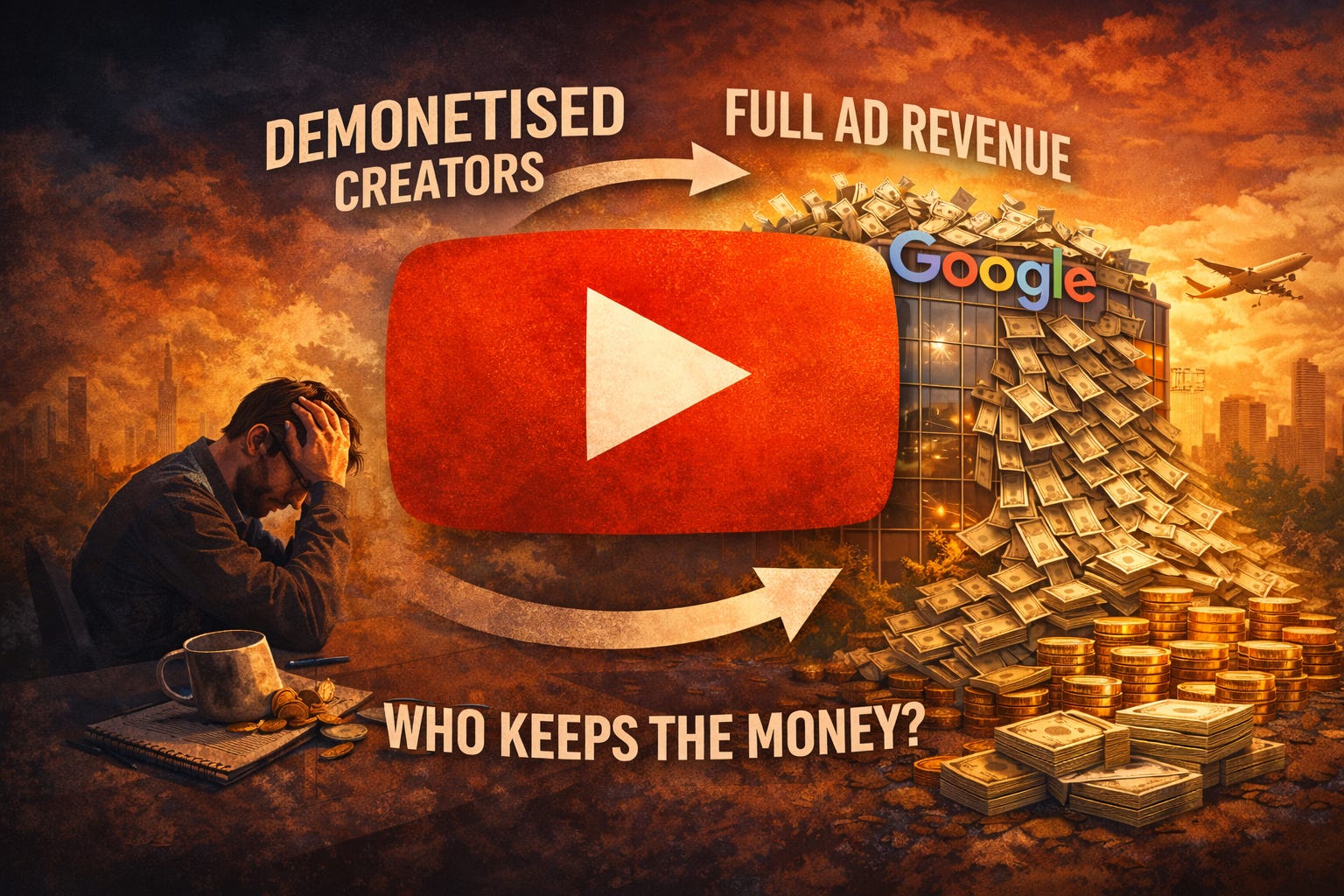
Every day, the same quiet drama plays out across the internet.
A creator wakes up, opens their dashboard, and sees the icon that has become the digital equivalent of a tax audit.
Yellow.
Or worse — red.
Monetisation disabled. Ads restricted. Revenue gone.
The explanation, if one arrives at all, is usually vague. Something about “advertiser-friendly guidelines.” Something about “sensitive or controversial topics.” Something about protecting brands from appearing next to content they might find uncomfortable.
And lately, if you look closely, there is a pattern that’s becoming increasingly difficult to ignore.
Content discussing Israel, Palestine, or Israel and any of the other countless countries that it has chosen to attack over the last… well, lifetime of Israel… is increasingly finding itself swallowed by YouTube’s demonetisation machinery.
Now before anyone rushes to turn this into a purely ideological argument — about politics, bias, or which side of a geopolitical argument someone happens to be on — there is a much more important question hiding underneath all of this.
A question that rarely gets asked.
Where does the money go?
Because when a creator gets demonetised, something very strange happens.
The content usually stays online.
The video doesn’t disappear.
The algorithm doesn’t suddenly stop recommending it.
The views keep coming in.
And in many cases, so do the ads.
Just not the revenue.
The Part No One Talks About
On the surface, demonetisation sounds straightforward.
If a video violates YouTube’s advertiser-friendly guidelines, it cannot generate advertising revenue for the creator.
That’s the official explanation.
Advertisers don’t want their brands associated with controversial topics, so the platform removes monetisation.
Simple.
Except in practice, that is not always how it works.
In recent years, YouTube quietly changed its policies to allow advertisements to run on videos that are not part of the YouTube Partner Programme.
In plain English, that means ads can appear on content even when the creator is not receiving any share of the revenue.
The money simply goes to Google instead.
And suddenly the logic behind demonetisation becomes a lot less clear.
If a video is truly “not advertiser friendly,” then advertisers shouldn’t be appearing on it at all.
But if advertisers are appearing on it, then the content clearly isn’t radioactive enough to keep brands away.
Which leaves us with a very uncomfortable possibility.
The content is controversial enough that the creator cannot be paid for it.
But not controversial enough that the platform (YouTube) cannot profit from it.
Follow The Incentives
To understand why this matters, you have to look at the incentive structure.
When a monetised creator publishes a video with ads, the revenue is shared between the creator and YouTube.
But when a creator is demonetised — and ads still appear — the situation changes.
The creator receives nothing.
The platform keeps everything.
Multiply that across millions of videos and billions of views and you begin to see the problem.
Demonetisation isn’t just a moderation tool.
It’s also a revenue redistribution mechanism.
The platform keeps the content.
The platform keeps the views.
The platform keeps the advertising inventory.
It simply removes the creator from the payment equation.
We’ve Seen This Before
None of this is entirely new.
Back in 2017, what became known as the “Adpocalypse” triggered the first major wave of large-scale demonetisation. Advertisers pulled back from controversial content, and YouTube responded by aggressively tightening its monetisation rules.
Entire categories of commentary — politics, news, war, social conflict — suddenly became financially risky to cover.
Since then, the list of topics that trigger demonetisation has only expanded.
War.
Political violence.
Terrorism.
Major global conflicts.
“Sensitive events.”
In other words: the exact topics that journalists, analysts, and commentators are supposed to talk about.
And in the current geopolitical climate, discussions around Israel and Palestine appear to be falling squarely inside that monetisation grey zone.
Videos stay up.
But revenue quietly disappears.
The Ethical Problem
This creates a conflict of interest that is impossible to ignore.
If a platform decides that a piece of content is too controversial for advertisers, there is a simple and principled solution.
Remove the dam advertising.
All of it.
Not just the creator’s share.
Because the moment ads continue to run on demonetised content, the platform becomes financially rewarded for removing creators from the revenue stream.
That is a perverse incentive structure.
And once it exists, it becomes very difficult to pretend that demonetisation decisions are purely about protecting advertisers.
The Legal Grey Area
There may also be legal questions lurking beneath the surface.
Creators enter into contractual agreements through the YouTube Partner Programme that define how advertising revenue is shared when ads appear on their content.
But when ads appear on videos where the creator is excluded from monetisation, the financial arrangement becomes far less transparent.
At that point, the platform is effectively monetising content while denying the creator any participation in the revenue generated by it.
Whether that crosses into illegality would depend on the exact wording of the terms and conditions and the regulatory environment in different jurisdictions.
But it undeniably creates a grey area around transparency, fairness, and revenue attribution.
The Obvious Solution
There is an incredibly simple fix for this entire problem.
If a video or channel is demonetised, all advertising on that content should stop.
Completely.
No pre-roll ads.
No mid-roll ads.
No display ads.
Nothing.
If the platform genuinely believes a topic is too controversial for advertisers, it should stand by that principle.
Because if the platform continues profiting from the content while the creator receives nothing, then demonetisation starts to look less like moderation…
…and more like a business model.
The Bigger Picture
YouTube isn’t just a website anymore.
It is one of the most powerful media infrastructures on the planet.
It shapes what gets discussed, what gets amplified, and increasingly — what creators can afford to talk about.
And when demonetisation becomes a financial lever that quietly punishes certain topics while allowing the platform itself to profit from them, the line between moderation and exploitation begins to blur.
Because if a piece of content is truly too controversial for advertisers…
then it should be too controversial for everyone.
Not just the person who made it.
If you found the issues about demonetisation and platform power here interesting, you might also enjoy reading another article I wrote last June: ‘We’ve Always Been at War with Digital Retention: How Orwell’s Dystopia Became Silicon Valley’s Business Model’.
That article delves into a more profound and concerning aspect of the modern internet: how easily digital information can be changed, hidden or removed. From the subtle editing of articles and social media posts to the deletion of historical newspaper archives and the power of technology companies to act on government ‘guidance’ to erase information completely. With almost everything we create now existing only in digital form—without analogue backups—censorship shifts from burning books to quietly pressing delete. This creates a world where the past itself can become surprisingly editable.
If this article about demonetisation highlights how platforms can control who gets paid for information, the earlier article looks at something even more fundamental:
Who gets to decide whether that information continues to exist at all. You can also find the link at the bottom of this page.
One slightly boring but annoyingly important thing to know before you go: because this piece is free, Substack’s algorithm treats it like a well-argued pamphlet handed out on a windy street corner — admirable, but largely ignored. The only way it escapes that fate is if actual humans do something with it.
If this made you think, nod, sigh, swear quietly, or forward it mid-paragraph to That One Person, please hit Share above, but not just here — Bluesky, UpScrolled, WhatsApp, group chats, emails, Insta-hell, the app formerly known as Twitter, or wherever discourse goes to loiter. This is how independent writing spreads now: person to person, not platform to algorithmic miracle.
If you want more of this — past, future, and whatever unsettling thing I’m currently digging into — hit Subscribe below. It’s free, unlocks everything, and tells the algorithm I’m not just yelling into the void on my own.
If you’re able and inclined to support the work financially, a few options:
There’s a Tip Jar below if you want to throw in whatever feels right
One-off support is always welcome and genuinely appreciated
Or there are paid subscriptions
A quick note on that last one: Substack has quietly decided that the cheapest paid tier is now $5 a month. That’s not my choice, I don’t love it, and I’m very aware that people often support multiple writers (which you absolutely should). The reason I even mention paid subscriptions isn’t about income — it’s because Substack aggressively promotes writers who have any paid subscribers at all.
So if $5 feels fine and you value the work, thank you — it genuinely helps it reach more people. If it doesn’t, please don’t. Subscribe for free, share the piece, leave a comment. That costs nothing and helps more than the algorithm would like you to know.
And if you’ve got thoughts, disagreements, additions, or want to argue with me politely or otherwise — the comments are open below.
Thanks for reading, for sharing, and for keeping independent writing alive on an internet that would very much prefer sponsored content and vibes.
— James.
Unique Reference Identifier
Article Reference ID: DR-YT-2026-03
What this is:
For transparency and archival purposes, this article has been assigned a unique reference identifier. The identifier allows readers to confirm they are viewing the original version of the editorial and makes it easier to reference, cite, or locate the article if it is mirrored, archived, or discussed elsewhere online.
In an era where digital content can be quietly edited, suppressed, or removed altogether, a permanent reference ID provides a simple way to track the existence and provenance of the piece over time.
2015 Alphabet Inc. was created as the parent company of Google, Alphabet adopted a new motto: “Do the right thing.”
That bold and honorable motto of “Do no evil” which Google had adopted at the turn of the new millennium was prominent in the companies culture , and even referenced in the founders’ letter for the company’s 2004 IPO. Google keep “Do no evil” in its internal code of conduct at that time, but it was completely removed in 2018.
So when your boss says "Do the right thing" instead of "Do no Evil" are we really surprised that , the once admired company has becomes a collaborator of the empire, and thus uses its might to ensure "right things" are done; That we do not speak, that we do not hear, nor see their evils.
It’s been many years since I have consciously logged on to Google, YouTube, Facebook, or TwiXter or TikTok.
I feel no loss, no lack of knowledge, no void in my understanding of life, politics, or culture.
These companies exist to devour freedom through predation and control, and we all must find ways to do without them, or we have no right to complain.