

How Taylor Sheridan Accidentally Reinvented State Media (With Better Hats)
It’s Only a TV Show—Until It Isn’t: Why Sheridan’s Neo-Western Universe Actually Matters

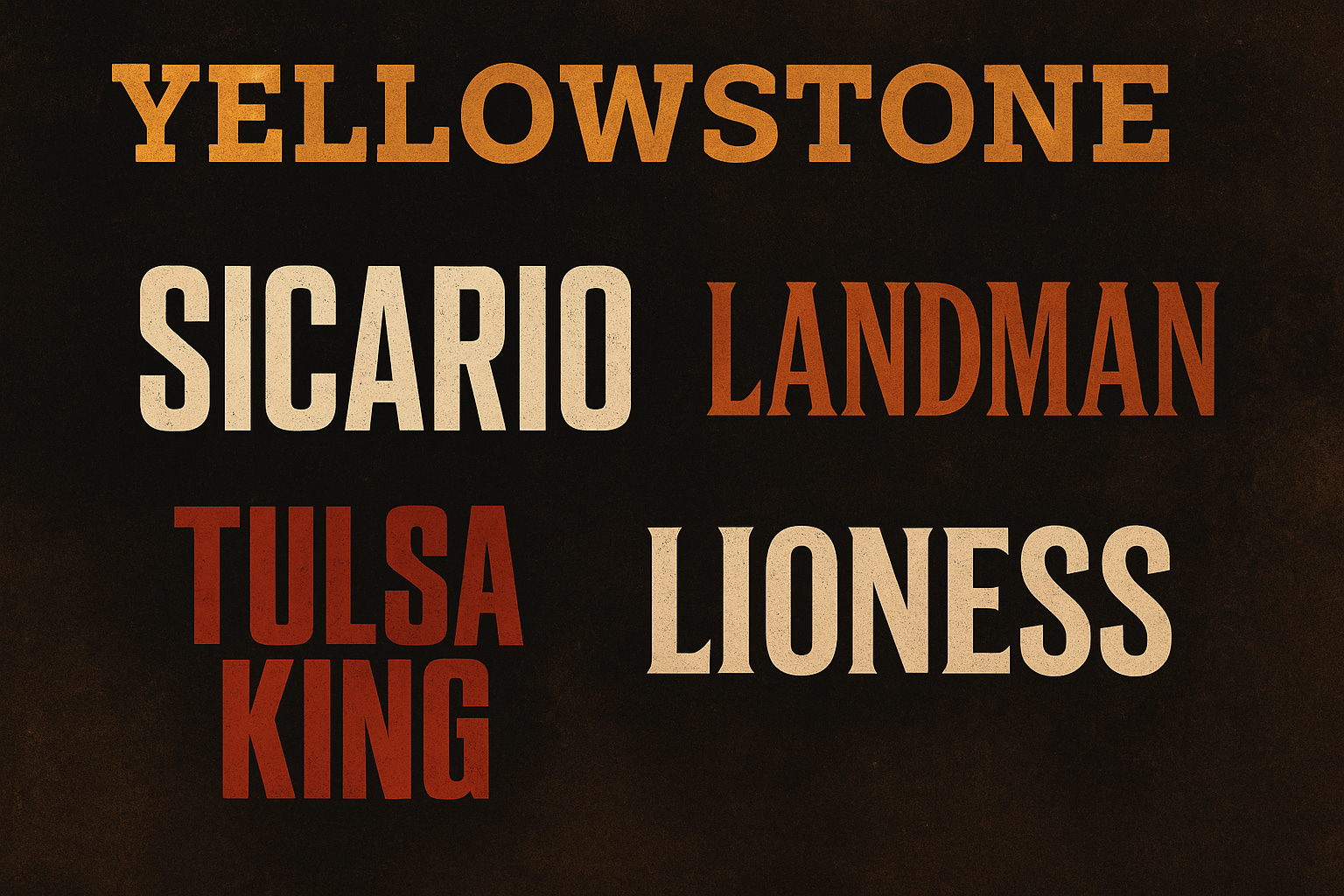
I should start with a confession: I genuinely like Taylor Sheridan’s work. I really do. The man makes compulsively watchable television. His shows are slick, muscular, beautifully shot, and usually armed with the kind of character development that makes you wonder if he personally interrogates his actors with a cattle prod until they produce emotional depth.
I’ve watched all of Yellowstone, all the Sicario films, Season One of Lioness, Season One of Landman, and I’m somewhere into Season Two of Tulsa King. I haven’t seen everything he’s made (I haven’t watched the Yellowstone prequels), but what I have seen? Very, very good. The man can craft a scene, construct a world, and write dialogue that feels like it’s been marinated overnight in Marlboro Reds and machismo.
However — and this is where the music screeches like a combine harvester trying to play a banjo — he also has a recurring habit of inserting extended, reverential odes to American institutions, frontier justice, and fossil-fuel exceptionalism, scored to the absolute worst audio torture known to humankind: modern American country music. Truly, it’s less “soundtrack” and more “interrogation technique illegally outsourced by the CIA.” For me, it’s like being trapped inside a sentient denim jacket that won’t stop singing at you.
But here’s the thing: this is not an anti-Sheridan piece.
This is a media literacy piece.
Because his shows aren’t “just” shows anymore.
They’re massive, global, binge-consumed cultural products that arrive preloaded with narratives, and those narratives, repeated enough, become common sense. Especially in a world where people spend more cumulative hours watching streamed dramas than consuming any form of journalism. Sheridan is not unique in this. But he is one of the most effective contemporary examples of how prestige television can quietly shape public sentiment — particularly when it flatters existing power.
And when you place that in the context of Paramount’s recent acquisition, and the looming possibility of Warner joining the same corporate corral, you suddenly have something much bigger than cowboys, oil men, and gritty cops.
You have soft power with a nine-figure budget, beamed straight into the global bloodstream.
The “It’s Just a TV Show” Problem (Spoiler: It Isn’t)
Whenever you critique politically slanted storytelling in mainstream entertainment, someone inevitably turns up — always with the confidence of a man who’s just discovered Wikipedia — to say:
“Mate, calm down. It’s just a TV show.”
Yes. And no.
It’s “just” a TV show in the same way a Big Mac is “just” lunch: sure, technically accurate, but completely ignoring the industrial-scale machinery behind the thing you’re absorbing.
Sheridan’s work attracts tens of millions of viewers. Entire demographics live inside these shows like emotional Airbnb tenants. A series with that kind of reach is not neutral. It can’t be. Especially when it repeatedly reinforces the same ideas, the same moral hierarchies, the same geopolitical framing, the same “good guys with big budgets” logic.
If your show is reaching more people than the evening news, then you don’t get to hide behind the soft-focus shield of “it’s just entertainment.” It becomes cultural oxygen.
This is not an accusation. It’s an observation. Sheridan isn’t single-handedly turning the global public into oil-patch nationalists. But he is absolutely participating in a very old tradition: stories that flatter the powerful shape how people understand the world, often without audiences realising it.
Which brings me to Landman.
Landman: The Finest Soft-Power Infomercial Ever Made About Hydrocarbons
Let me be clear again: Landman is extremely well-made, and I’m currently watching it and, I’m loving it. I promise, that will be my last McDonald's reference. Billy Bob Thornton is world-class. Some episodes are as slick as The Social Network mainlined through a Texan refinery.
But buried in all the narrative craftsmanship is something quietly remarkable: a consistent, sympathetic, articulate defence of the fossil-fuel industry, delivered with the emotional gravitas of a man who looks like he bathes exclusively in petrol.
And the best example — the real Rosetta Stone of Sheridanism — is that monologue in the “Tickler” teaser.
If you’ve seen it, you’ll remember the one.
The oilfield guy (Tommy / Billy Bob) gestures at the vast rows of wind turbines and explains — convincingly, eloquently — that they’re only there because the drill sites are off-grid and need independent power. He then rolls seamlessly into the kind of anti-renewables argument that sounds both informed and reasonable:
• Wind turbines cost a fortune
• They require huge industrial inputs to manufacture
• They have a limited working lifespan
• Their energy return takes years to offset production
• They’re not as “clean” as PR departments would have us believe
And — crucially — some of that is true. Not all, not most, but enough that a viewer without detailed knowledge walks away thinking:
“Ah. Renewables aren’t actually viable. Good thing we have oil.”
This is the genius of the scene: it moves incredibly quickly, like a TED Talk sponsored by Exxon, firing off factoids with such confidence that you don’t notice what’s missing.
And what’s missing is enormous.
What the Scene Never Mentions:
If renewables were truly useless — if they were just expensive green cosplay — then why do oil and gas giants consistently:
• buy promising renewable start-ups,
• shutter them quietly,
• bury the technology, and
• lobby aggressively against national clean-energy transitions?
Those are not the actions of an industry unbothered by competition.
Those are the actions of an industry that knows precisely how vulnerable its long-term business model is.
This isn’t conspiracy. It’s documented behaviour.
There are case studies spanning decades of fossil-fuel conglomerates buying up emerging renewable technologies specifically to kill the threat.
Yet in Landman, the monologue never goes there — even though the character giving it absolutely would know that information.
Now, in fairness, this character in real life probably wouldn’t. It’s not in his best interest. He’s a man whose livelihood depends on his industry’s longevity and ongoing success. But the problem is that this counterpoint never gets addressed.
And that’s the point.
Sheridan isn’t lying.
He’s curating.
And curation is where soft power lives.
This Pattern Appears Across Sheridan’s Universe
This isn’t a one-off phenomenon. Across Sheridan’s shows, you see the same selective framing:
• Yellowstone champions frontier justice and private land rights with the fervour of an NRA policy workshop.
• Lioness sanitises America’s murkiest counter-terror operations by grounding them in sympathetic character arcs.
• Sicario presents the U.S. intelligence apparatus as a weary, morally distressed, but ultimately indispensable force of order.
• Landman recasts the oil industry as a misunderstood protagonist doing God’s work in the Permian Basin.
None of these are propaganda in the moustache-twirling sense. They’re simply stories told from one consistent point of view.
But when that point of view always aligns with American power — and when those stories are watched by tens of millions — the result becomes functionally indistinguishable from soft influence.
Especially when the studios behind them keep consolidating.
Paramount, Warner, and the Coming Age of Consolidated Narratives
The acquisition of Paramount, and the likely pursuit of Warner next, isn’t just a business story. It’s an ideological one.
As media conglomerates merge, a smaller number of executives control an ever-greater share of the cultural output that defines public understanding of:
• America’s role in the world
• Energy politics
• National security
• Law enforcement
• “Real American values”
• The supposed failure of anything not powered by diesel
If your entertainment diet increasingly comes from one mega-stable of studios — all interlinked, all shareholder-driven, all sensitive to political pressure — then the line between narrative and national myth starts to dissolve.
And Sheridan, whether intentionally or not, is now one of the most effective myth-makers operating inside that system.
What This Actually Means for Viewers
This is not an argument against enjoying these shows. I enjoy them enormously. People are allowed to like things.
But we should watch them with our eyes open.
If a prestige drama folds a geopolitical argument into a character monologue — and twenty million people watch it in a single weekend — that is not neutral.
That is a classroom with a budget.
That is civic storytelling with a body count.
That is information, not incidental flavour.
Sheridan’s universe is thrilling, well-acted, addictive television.
It’s also one of the most successful delivery mechanisms for American soft power currently operating without a Pentagon contract, although Paramount 2.0 with not too many degrees of separation, actually do.
Both things can be true.
And pretending it’s “just a TV show” is exactly how narratives become default truths.
And this is where the broader Sheridan catalogue becomes even harder to dismiss as “just telly.” Across his various universes, the same thematic fingerprints keep showing up like a drunk uncle at a wedding: ancient land claims in Yellowstone reframed as a noble settler struggle rather than a centuries-late reckoning with Indigenous sovereignty; the toxic, co-dependent US–Mexico security relationship in Sicario, sold through the lens of a forever-war where the CIA only ever seems one morally grey monologue away from waterboarding the concept of due process; and Tulsa King, where the American dream is (apparently) best pursued by a 70-something mafioso reinventing himself as a libertarian small-business guru. The details change, but the narrative scaffolding doesn’t: the system is corrupt, institutions are useless, and only the lone, morally flexible maverick can save civilisation from collapsing under the weight of its own regulations. It’s a worldview that doesn’t merely echo the talking points of America’s newly re-empowered right-wing government—it practically storyboards them. In a media landscape where streamed drama now does more political education than most civics classes, that repetition matters.
Sheridan isn’t telling us what to think, but he is telling us what to normalise: power without oversight, borders without nuance, land without history, and justice without courts. And if we start recognising those patterns—really seeing them—we might catch ourselves before mistaking a beautifully shot myth for an operating manual on how the world ought to work.
Thank you for reading! If you liked this article, please remember it was free to read and as such, Substack won’t push it as much as paid content. Please take a second to hit the Share button above and if you’d like to see more content like this, please click the subscribe button below to Subscribe for free future, and past content.
If you’re interested in supporting my work, one off donations on Ko-fi can be as little as the price of a coffee. There is Tip Jar Button below where you can tip whatever you’d like. For those looking to provide long-term support, there are annual subscriptions available through the Substack subscription page. Every contribution, no matter how small, is greatly appreciated! Otherwise, I’d still love that Sub & Share, which costs absolutely nothing!
Many thanks, James.
References:
https://en.wikipedia.org/wiki/Taylor_Sheridan
https://en.wikipedia.org/wiki/Sicario_(2015_film)
https://www.imdb.com/name/nm0792263/
https://www.cnet.com/tech/services-and-software/taylor-sheridan-has-9-tv-shows-streaming-heres-where-to-watch-all-of-them/
https://www.thestorydepartment.com/script-reader-michael-sweeney-on-script-reading-taylor-sheridan-and-the-future-of-screenwriting/
https://collider.com/taylor-sheridan-35-million-neo-western-sicario-2-streaming-success-novemeber-2025/
https://screencraft.org/blog/screenwriting-wisdom-from-oscar-nominated-screenwriter-taylor-sheridan/
https://www.britannica.com/biography/Taylor_Sheridan
https://www.hollywoodreporter.com/business/business-news/taylor-sheridan-move-why-yellowstone-is-on-peacock-1236410771/
https://www.whiskeyriff.com/2025/10/21/why-yellowstone-creator-taylor-sheridan-prefers-to-write-his-scripts-completely-alone/
Check out 1883.